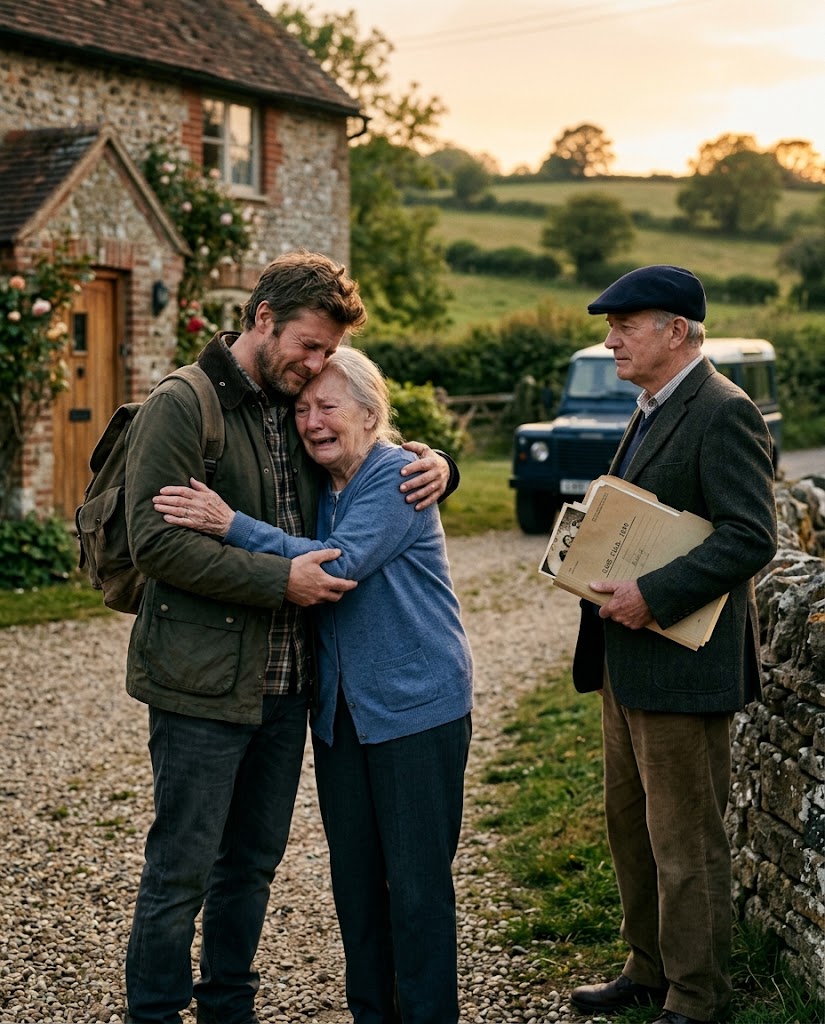
For twenty-five years, my mother’s disappearance was the unanswered question that shaped my entire life. I was only seven years old when she vanished, but the memory of that night remained clearer than almost anything else from my childhood. I remembered sitting on the living room floor while my father walked from room to room, calling her name. I remembered the fear in his voice. I remembered neighbors gathering outside while police officers searched around our house. I remembered Detective Michael Reed kneeling beside me and promising, “We will find your mother.” At that age, I believed him completely. I thought the police always found answers. I thought every mystery had an ending. But as the years passed, my mother’s case became one of those stories people whispered about and eventually stopped discussing. She became a photograph on the wall, a name spoken quietly, and a memory that everyone was afraid to disturb.
My mother, Sarah Bennett, was not the kind of person who disappeared without a reason. She was organized, loving, and deeply connected to our family. She planned everything. She remembered every birthday. She saved every drawing I made as a child. She was the person who made our small home feel safe. That was why her disappearance never made sense. There were no signs that she wanted to leave. Her clothes were still in the closet. Her favorite books were still beside her bed. The garden she loved caring for was still full of flowers she had planted herself. Everything about our home said she was coming back. But she never did. For years, people created their own explanations. Some believed she had run away. Others believed something terrible had happened. My father always believed she was still out there somewhere. He spent years searching, even when everyone else told him to stop.
Growing up without my mother changed me in ways I did not understand at first. My father tried his best to give me a normal childhood, but there was always an empty space in our home. There were moments when I needed my mother and wondered where she was. I wondered if she thought about me. I wondered if she missed me. The hardest part was not knowing whether she left by choice. If someone told me she was gone forever, maybe I could have accepted it. But not knowing created endless possibilities. Every unknown person I saw in public made me wonder if it could be her. Every phone call made me hope it was news about her. Even after twenty-five years, a small part of me remained that seven-year-old child waiting for his mother to walk through the door.
Detective Michael Reed became a familiar name in my family because he was the officer who never gave up on the case. Many detectives eventually move on when cases become inactive, but Reed continued reviewing information long after others stopped. He attended every new lead. He contacted old witnesses. He returned to places connected to the investigation. My father respected him because he believed Reed was the only person who truly understood how much Sarah mattered to us. But as I became older, I started questioning something. Why did Reed continue searching when everyone else had accepted that the truth might never be found? Why did he spend so much of his career connected to one missing person case? I assumed it was because he wanted justice. I never imagined it was because he knew something about my mother that nobody else knew.
After my father passed away, I finally decided to look deeper into my mother’s disappearance. Losing him made me realize that I could not spend my entire life waiting for answers. I started organizing old family belongings and searching through documents he had left behind. Most of what I found were ordinary memories. Photos. Letters. Old family records. But one photograph caught my attention. It showed my mother standing beside Detective Michael Reed outside an unfamiliar building. They were not arguing. They were not in a police setting. They looked like two people having a serious conversation. On the back of the photograph, my mother had written five words: “He knows what happened.” I stared at that sentence for a long time. My first thought was confusion. My second was anger. If Detective Reed knew something, why had he never told us? Why had he allowed my family to suffer for twenty-five years?
I contacted Detective Reed, who had retired years earlier and moved away from the city. I expected him to be surprised by my call, but when I mentioned my mother’s name, there was a long silence. Then he said something that immediately caught my attention. “I always wondered when you would come looking for the truth.” I asked him what truth he meant. His answer changed everything. “The truth about why your mother disappeared.” When I met him in person, he looked older than the man I remembered from my childhood. His hair was gray. His movements were slower. But his eyes still carried the same seriousness I remembered. Before I could ask my questions, he apologized. Not a casual apology. A painful one. “I should have told you sooner,” he said. “But I made your mother a promise.”
I struggled to understand. A promise? What kind of promise could be more important than telling a child what happened to his missing mother? Detective Reed explained that the night Sarah disappeared, she had not been taken against her will. She had left intentionally. Hearing that was like being hit by a wave. For twenty-five years, my family believed we had lost her. We believed someone had taken her. But Reed explained that Sarah had planned her disappearance because she believed it was the only way to protect me. I immediately became angry. How could leaving a child protect him? How could a mother choose to disappear? Reed understood my reaction because he had asked himself the same question years earlier.
He explained that Sarah had discovered something dangerous before she disappeared. She worked as an accountant for a company that handled large financial transactions. During her work, she uncovered evidence of illegal activities involving people who had influence and power. At first, she believed reporting the information would solve the problem. She believed the truth would protect innocent people. But she soon realized the people involved were willing to do anything to prevent the information from becoming public. They began watching her. They followed her. They learned about her family. When Sarah realized they knew about me, she became terrified. Not for herself. For her child.
Detective Reed told me that Sarah came to him privately before she disappeared. She did not trust many people because she did not know who was involved. She showed him the information she had collected and explained her fears. She believed that if she stayed, I could become a target. Reed tried to convince her there had to be another solution. He told her she should not have to lose her family to protect them. But Sarah had already made her decision. She believed that if everyone thought she disappeared, the people looking for her would stop searching for a connection to me. “Your mother did not leave because she wanted a different life,” Reed said. “She left because she wanted you to have a life.”
I wanted to understand, but I was still hurt. Twenty-five years without a mother could not be erased by one explanation. I asked Reed why she never came back after the danger passed. He looked down and said, “Because she was afraid.” He explained that the longer Sarah stayed away, the harder returning became. She watched me grow from a distance. She knew when I graduated. She knew when I started my career. She knew when my father became sick. But every time she wanted to return, she feared that her appearance would reopen the danger. She believed that the safest way to love me was from far away.
Then Detective Reed told me something I never expected to hear. My mother was alive. For twenty-five years, I had prepared myself to accept that I would never know the truth. I had imagined every ending except this one. Sarah had been living quietly under a different name in a small town several hours away. Reed had remained in contact with her because of the promise he made. He promised that he would only reveal her location when he believed it was safe. The reason he finally contacted me was because Sarah’s health had begun to decline, and she no longer wanted to lose more time.
The journey to meet my mother felt unreal. I had spent half my life imagining what I would say if I ever saw her again. I thought I would be angry. I thought I would demand answers. But when I stood outside her home and saw her open the door, all those prepared words disappeared. She looked older. Twenty-five years had changed her. But I recognized her immediately. I recognized her smile. I recognized her eyes. For a moment, neither of us spoke. Then she whispered my name. Not my adult name. The childhood nickname she used when I was seven years old. That single word brought back memories I thought I had forgotten.
The first thing Sarah did was apologize. She cried as she told me she was sorry for every birthday she missed, every milestone she could not celebrate, and every moment I needed her. I wanted to ask why she made that choice. I wanted to tell her how much I suffered. And I did. I told her about the years of confusion. I told her about the anger I carried. I told her how many times I wondered if I mattered enough for her to stay. Sarah listened without defending herself. Then she said something I will never forget. “You were the only reason I left.” She explained that every decision she made was because she loved me. She accepted that I might hate her because she believed my safety mattered more than her place in my life.
Sarah showed me the life she had lived during those years. It was not a happy escape. It was a quiet existence built around waiting. She kept photographs of me. She kept updates about my life. She celebrated my achievements from a distance. She never created another family because she never wanted to replace the one she had lost. Seeing that was painful because I realized we had both lost twenty-five years. I lost my mother. She lost being my mother. The difference was that she carried the pain because she believed it was necessary.
Detective Reed later explained that he had spent years trying to bring the truth to light. The people who had threatened Sarah were eventually investigated, but the process took decades. He kept the case alive because he knew Sarah’s story was incomplete. He knew my family deserved answers. He also admitted that keeping the secret was one of the hardest decisions he ever made. “Every time I saw you asking about your mother, I wanted to tell you,” he said. “But I gave her my word.”
As the truth became public, my mother’s name was finally cleared. People who had once wondered whether she abandoned her family learned the real story. She was not someone who walked away. She was someone who sacrificed her own happiness to protect her child. But for me, the most important part was not what others thought. It was finally understanding her.
Rebuilding a relationship after twenty-five years was not simple. We could not pretend that time had not passed. There were painful conversations. There were moments when I struggled with forgiveness. Love does not erase lost years. But slowly, we created something new. My mother learned about the adult I had become. I learned about the woman she had always been. We could not recover the past, but we could choose what to do with the time we had left.
I also understood Detective Reed differently. For years, I thought he was the person who kept the truth from me. But after learning everything, I realized he was the person who carried the burden of protecting it. He had watched my family suffer because he believed it was the only way to honor my mother’s choice. He was not hiding the truth to hurt us. He was protecting the promise he made.
Today, when I think about my mother’s disappearance, I no longer see only the pain. I see the sacrifice behind it. I see a mother who gave up twenty-five years of being present because she believed it was the only way to keep her child safe. I see a detective who carried a secret because he believed a promise mattered. And I see a family that finally found the truth it had been searching for.
For most of my life, I searched for the person who took my mother away.
I never expected to discover that my mother was the person who chose to disappear to protect me.
The police officer who investigated her case for years was not the person hiding the truth.
He was the person who had been protecting it until the right moment came.
And when I finally learned my mother’s secret, I discovered something I had forgotten.
Sometimes people leave not because they stop loving us.
Sometimes they leave because their love is the reason they have to go.